
Helping kids build confidence in social situations using a holistic approach means looking beyond surface behaviors and considering the whole child: their emotions, sensory needs, communication skills, past experiences, and environment. For many children, social settings like classrooms, playgrounds, or group activities can feel overwhelming, especially when regulation, transitions, or peer dynamics are challenging. A holistic lens recognizes that confidence isn’t just about “trying harder” socially; it’s about supporting the underlying skills that help children feel safe, capable, and connected. When adults address emotional regulation, sensory processing, executive functioning, and relationship-building together, children are better able to navigate social moments with confidence and resilience.
Our next resource in our series on social skills through a holistic lens covers confidence in kids.
Confidence and self-esteem are foundational to a child’s ability to participate fully in school, friendships, and everyday life. Yet many parents and professionals hear the same questions over and over:
- How can I help my child gain confidence?
- How can I build self-esteem in my child?
- My child avoids new situations. What should I do?
When children struggle socially, confidence is often one of the first things impacted. A holistic approach looks beyond surface behaviors and considers the emotional, sensory, physical, and communication-based factors that influence how confident a child feels in social situations. When we get into handling big emotions, we might see even more confidence issues.
Confidence Is More Than Personality
Confidence is not simply a trait a child is born with. It develops over time through experiences, relationships, and feeling successful in everyday interactions.
Some children appear confident naturally, while others hesitate, withdraw, or avoid social situations. This does not mean something is “wrong.” We might see times where the child is highly sensitive to their situations and environments in social situations and confidence then is a true struggle. Often, it means there are underlying skills still developing, such as:
- Emotional regulation
- Sensory processing
- Communication skills and language
- Motor planning and body awareness
- Executive functioning
A holistic lens recognizes that confidence grows when these systems are supported together.
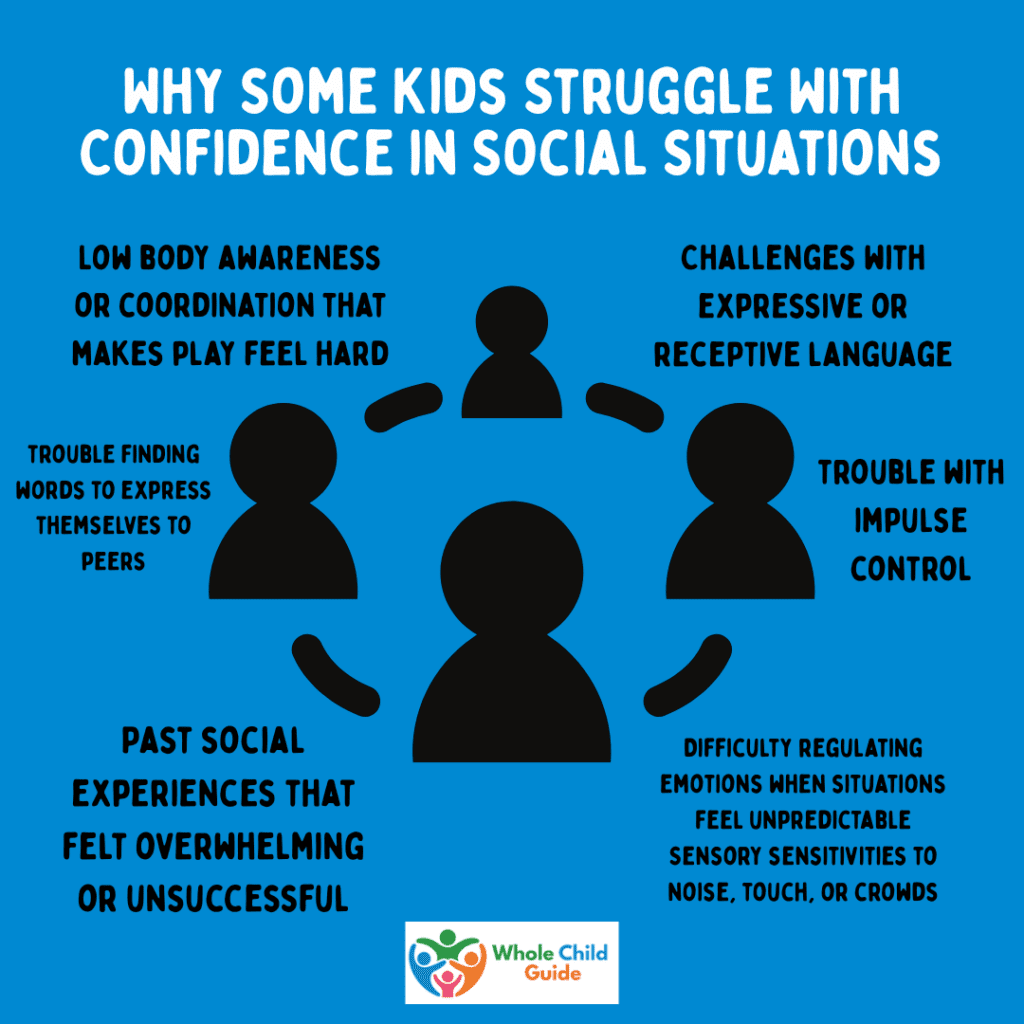
There are many reasons why confidence may be challenging for kids.
Why Some Kids Struggle With Confidence in Social Situations
Children may avoid social settings or appear anxious for many reasons, including:
- Difficulty regulating emotions when situations feel unpredictable
- Sensory sensitivities to noise, touch, or crowds
- Challenges with expressive or receptive language
- Low body awareness or coordination that makes play feel hard
- Past social experiences that felt overwhelming or unsuccessful
- Trouble with impulse control or other executive functioning skills
- Difficulty finding words to express themselves or to respond to peers in conversation
A child who struggles socially may not lack motivation or desire for connection. They may lack the tools their nervous system needs to feel safe and capable.
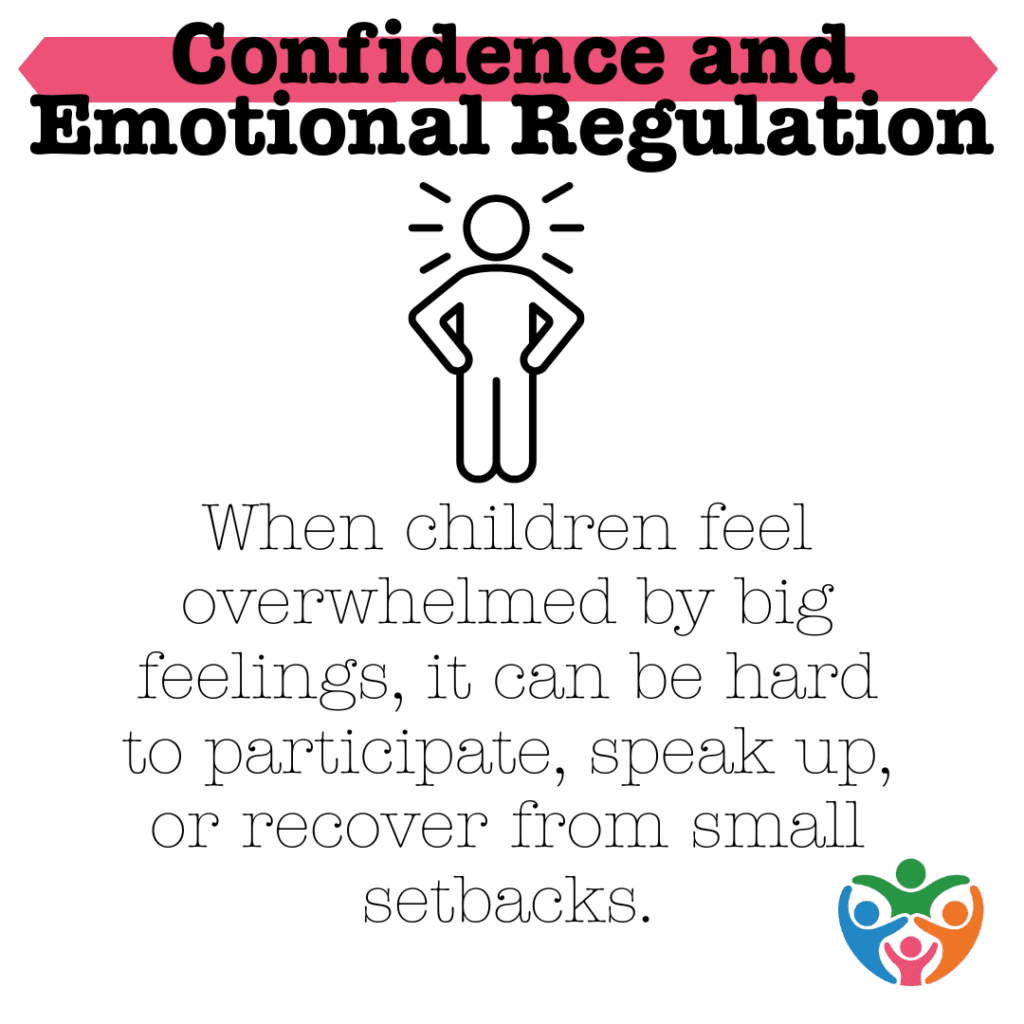
Next, we’ll cover the role of emotional regulation in confidence. This is an important area to include because of the role of emotional regulation in so many other aspects of social skills.
Confidence and Emotional Regulation
Emotional regulation plays a key role in social confidence. When children feel overwhelmed by big feelings, it can be hard to participate, speak up, or recover from small setbacks.
Supporting emotional regulation may include:
- Predictable routines that reduce uncertainty
- Visual supports that help children know what to expect
- Calm-down strategies that match the child’s sensory needs
- Adult modeling of emotional language and coping skills
Parent coaching, counseling, and occupational therapy often focus on helping children understand their emotions and build confidence in managing them.
The Role of Sensory Processing in Confidence
Sensory sensitivities can significantly impact how a child experiences social environments. Loud classrooms, crowded playgrounds, or unfamiliar textures can make children feel dysregulated and unsure of themselves.
Occupational therapy can support sensory processing and help children develop strategies that allow them to feel more comfortable and confident in social settings. Simple sensory supports at home and school can make a big difference in how willing a child is to engage with peers.
Communication Skills and Social Confidence
Children who struggle to express themselves or understand social language often feel less confident in group settings. Difficulty with conversation, turn-taking, or understanding social cues can lead to withdrawal or frustration.
Speech therapy and language-based supports can help children:
- Express needs and ideas more clearly
- Understand social expectations
- Build confidence in peer interactions
- Repair communication breakdowns
When communication becomes easier, confidence often follows.
Physical Skills, Movement, and Confidence
Confidence is also influenced by how children feel in their bodies. Gross motor skills, coordination, posture, and endurance all affect participation in play and group activities.
Physical therapy and movement-based activities can help children feel more capable during games, sports, and playground interactions. Feeling physically confident often supports social confidence as well.
Supporting Confidence at Home Using a Holistic Lens
Parents can support confidence-building through everyday interactions. For example, we can help kids improve social skills through play. Some other ideas are:
- Offering opportunities for low-pressure social experiences
- Celebrating effort, not just outcomes
- Allowing children to practice new skills in familiar environments
- Supporting independence in daily routines
- Validating feelings while encouraging gradual challenges
Confidence grows through repeated experiences of being supported, understood, and capable.
How Professionals Can Support Confidence Using a Whole-Child Perspective
Professionals working with children often collaborate to support confidence across settings. This may include:
- Occupational therapy for regulation and sensory processing
- Speech therapy for communication and social language
- Physical therapy for movement and coordination
- Counseling or parent coaching in mental health support for emotional awareness
- Parent coaching to support carryover at home
A holistic approach recognizes that no single strategy works in isolation. Confidence builds when systems work together.
How the Whole Child Guide Helps Families Find the Right Support
The Whole Child Guide was created to help families and professionals connect through a whole-child lens. Instead of searching randomly, caregivers can explore support based on a child’s specific needs, including:
- Emotional regulation
- Communication challenges
- Sensory processing needs
- Motor development
- Social skills and confidence
Families can use Whole Child Guide to find occupational therapists, physical therapists, speech therapists, counselors, parent coaches, and other professionals who understand child development from a holistic perspective.
Confidence Grows When Children Feel Supported
Helping children build confidence in social situations is not about pushing them to “be more outgoing.” It is about understanding what they need to feel safe, capable, and connected.
When children are supported emotionally, physically, sensorially, and socially, confidence becomes a natural outcome—not a forced goal.
If you are looking for professionals who support confidence and self-esteem through a whole-child approach, explore the resources and directory on Whole Child Guide to find support that fits your child’s unique needs.
Are You a Professional Who Supports the Whole Child?
Join the Whole Child Guide Membership for professionals and get:
✅ Unlimited access to all our printables — organized for easy use in therapy, education, and parent support
✅ A high-visibility listing in our Business Directory — where families search based on their child’s needs
✅ Access to Downloadable Business Growth Workbooks to grow the impact of your practice
✅ The WCG Business Builder Tool to help you reach aligned families and grow sustainably
✅ All for just ONE annual fee — a marketing write-off that works smarter, not harder
👉 Join Whole Child Guide for Professionals
Together, let’s connect more families with the care they need.