
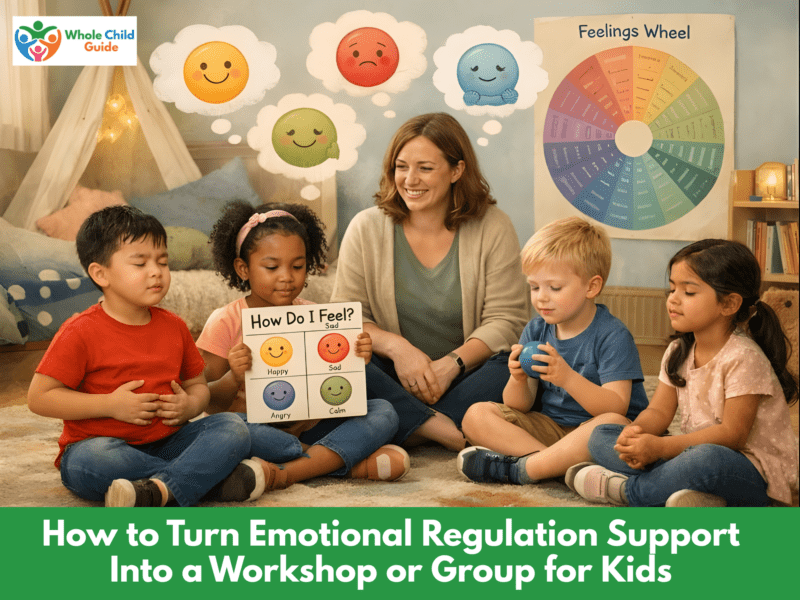
Emotional regulation is the ability to manage and respond to emotional experiences in healthy, adaptive ways. It involves recognizing emotions, understanding what triggers them, modulating their intensity, and choosing appropriate responses rather than reacting impulsively. This foundational skill affects every aspect of a child’s life: relationships, learning, behavior, mental health, and overall wellbeing. When children can regulate their emotions, they can navigate disappointments, handle frustration, recover from setbacks, and maintain relationships even when things get difficult. Here are some suggestions to learn how to turn emotional regulation support into a workshop or sessions for parents and kids.
Emotional regulation works closely with other developmental areas. Executive function skills help children pause and plan responses to emotions, while sensory processing differences can significantly impact a child’s ability to stay regulated. Even quality sleep plays a crucial role in emotional regulation, as tired children have shorter fuses and bigger reactions.
Challenges in this area might look like:
- Explosive meltdowns over minor frustrations (going from calm to screaming in seconds)
- Difficulty calming down once upset (tantrums lasting 30+ minutes)
- Intense reactions that seem disproportionate to the situation
- Hitting, throwing, or destroying things when angry or overwhelmed
- Shutting down or withdrawing completely when emotions feel too big
- Difficulty identifying or naming their emotions beyond “mad” or “sad”
- Quick emotional shifts (laughing one moment, crying the next)
- Anxiety that interferes with daily activities, sleep, or social participation
- Difficulty transitioning between activities without emotional outbursts
- Problems at school due to emotional reactivity (sent to the office frequently)
When emotional regulation improves, you’ll see:
- Children pausing before reacting when upset or frustrated
- Ability to name and communicate feelings with words instead of behaviors
- Shorter recovery time after emotional upset
- Use of coping strategies independently (deep breathing, asking for space, using calming tools)
- Better frustration tolerance during challenging tasks
- Improved peer relationships with fewer conflicts
- More flexibility when plans change or expectations aren’t met
- Increased confidence tackling new or difficult situations
- Parents feeling more equipped to support rather than escalate emotions
- Reduced family stress and more peaceful home environments
Possible Services to Provide Emotional Regulation Support
Professionals can build various offerings around emotional regulation, depending on their setting, training, and audience. Choose one or more of the following models:
- Parent Education Workshop (Virtual or In-Person)
- Parent-Child Group or Play Session
- Individual Session (Private Coaching, Consultation, or Insurance-Based)
- Professional Development Training for Staff or Teams
Each version below includes structure, pricing, and implementation guidance. For more ideas on how to structure your whole child approach, see our guide on creating a clearer way forward in your practice.
Session Format and Structure
1. Parent Education Workshop – “Building Emotional Regulation: Tools for Big Feelings”
Length: 60–75 minutes
Audience: Parents and caregivers
Setting: Community center, clinic, school, or virtual
Structure Example:
Welcome & Icebreaker (5–10 min)
Greet parents and introduce the topic. Ask: “What does your child’s emotional dysregulation look like at home?”
Common answers: explosive tantrums, aggression, shutting down, anxiety spirals, sibling conflicts, morning or bedtime meltdowns.
Foundations & Science (10–15 min)
Explain how emotional regulation develops and functions:
- Brain development (the prefrontal cortex regulates the amygdala; this system is still developing through age 25)
- Window of tolerance (optimal arousal zone vs. hyper-arousal and hypo-arousal)
- The stress response (fight, flight, freeze, fawn and what they look like in children)
- Co-regulation before self-regulation (children learn to regulate through connection with calm caregivers)
- How trauma, anxiety, ADHD, and sensory differences impact regulation (for more on sensory processing, see our sensory support guide)
- Developmental expectations (what’s typical for different ages: toddler tantrums vs. school-age meltdowns)
Share that emotional regulation is a skill that develops over time with practice, modeling, and support, not something children should “just know.”
Practical Strategies (15–20 min)
Demonstrate 3 home-ready strategies:
- “Name It to Tame It” – Teach emotion vocabulary and labeling. Show feelings charts, emotion wheel, or feelings flashcards. Model narrating emotions: “I notice your body looks tense and your voice is getting louder. I wonder if you’re feeling frustrated?” Explain how naming emotions reduces their intensity.
- “The Calm-Down Toolkit” – Introduce specific regulation strategies for different states: deep breathing exercises (belly breathing, square breathing, bubble breaths), movement breaks (jumping jacks, wall pushes, yoga poses), sensory tools (fidgets, weighted items, calming music), quiet space with comfort items. Demonstrate 2-3 techniques parents can teach.
- “Connection Before Correction” – Explain that children can’t learn or problem-solve when dysregulated. Show how to connect first (get on their level, empathize, validate feelings) before teaching or redirecting. Role-play the difference between reacting and responding.
Parent Reflection & Q&A (15–20 min)
Facilitate discussion:
- “What triggers your child’s biggest emotional reactions?”
- “What helps them calm down? What makes things worse?”
- “What’s your biggest challenge: staying calm yourself, knowing what to do, or partner disagreement?”
- Address common concerns: “Am I rewarding bad behavior?” or “Will they ever learn to control themselves?”
Wrap-Up & Takeaway (10 min)
Provide a “Regulation Toolbox” handout with:
- Feelings chart with faces and body clues
- 10 calming strategies kids can use
- Scripts for connection before correction
- When to seek professional support (safety concerns, persistent challenges beyond age expectations)
Suggested Price:
- $25–35 per parent (virtual or community event)
- $200–300 flat rate for school or mental health center-hosted events
Value Add: Include downloadable feelings charts, calming strategy cards, and a guide to building a home calm-down corner.

2. Parent-Child Playgroup or Group Session – “Feelings Detectives: Learning to Understand and Manage Big Emotions”
Length: 45–60 minutes
Audience: Small group of 4–6 children (ages 4–10) with parent participation
Setting: Clinic, community center, school counseling room, or library
Structure Example:
Welcome Circle (5 min)
Use a feelings check-in ritual: “Let’s go around and share your name and how you’re feeling right now using our feelings chart.”
Normalize all emotions: “All feelings are okay. We’re learning what to do with them.”
Model the Skill (5–10 min)
Introduce today’s focus (e.g., “What to Do When You Feel Angry” or “Calming Your Body”) through:
- A children’s book about emotions (The Color Monster, When Sophie Gets Angry, The Way I Feel)
- Puppet show where a character practices a calming strategy
- Brief discussion: “What does anger feel like in your body? Where do you notice it?”
Interactive Play Stations (20–25 min)
Rotate through 2–3 stations that build emotional awareness and regulation:
Station 1: Emotion Identification Activities
Use feeling faces matching games, emotion charades, or mirrors for making feeling faces. Read scenarios and identify emotions: “Your friend took your toy without asking. How might you feel?” Parents coach: “You identified that feeling! That’s the first step.”
Station 2: Calming Strategy Practice
Set up stations for different techniques: breathing exercises with pinwheels or bubbles, yoga pose cards, calming sensory bin, guided imagery with picture cards, progressive muscle relaxation. Kids try each and identify favorites. Parents note what works: “I see that deep breathing really helped your body calm.”
Station 3: Problem-Solving Through Play
Use dolls or action figures to act out common emotional scenarios (sharing conflict, disappointment, frustration with difficult task). Practice identifying the feeling, trying a calming strategy, then problem-solving. Parents facilitate: “What could this character do differently?”
Parent Coaching Moment (During Play)
Circulate and coach parents:
- “Notice how you stayed calm when they got frustrated. That’s modeling regulation.”
- “Great job validating the feeling before suggesting a solution.”
- Point out when children successfully use a strategy, even partially.
Reflection & Goodbye Routine (5–10 min)
Circle back together. Ask each child: “What’s one calming strategy you tried today that you could use at home?”
Give each child a “Feelings Helper Card” with their favorite calming strategy illustrated and one situation to practice it this week.
Suggested Price:
- $20–25 per child per session
- $75–100 for a 4-week series (“Understanding Feelings,” “Calming Strategies,” “Big Feelings Like Anger,” “Managing Worry and Fear”)
Value Add: Include take-home feelings charts, calming strategy cards, and small sensory tools (stress ball, breathing pinwheel).
3. Individual Session for Emotional Regulation Support – “Personalized Emotional Regulation Support”
(Private Coaching, Consultation, or Insurance-Based Therapy)
Length: 45–60 minutes
Audience: Individual child or teen (with parent check-in)
Setting: Clinic, school counseling office, home visit, or telehealth
Structure Example:
Connection & Assessment (10–15 min)
Begin with relationship-building and informal assessment:
- Use a feelings check-in tool (scale of 1-10, feelings thermometer, zones of regulation check)
- Play-based observation of frustration tolerance and regulation strategies
- Discuss recent emotional challenges: “Tell me about a time this week when you had really big feelings.”
- Assess current regulation skills, triggers, and what helps vs. what doesn’t
Targeted Skill Building (20–25 min)
Engage the child in activities tailored to their specific needs:
- For a child with poor emotion awareness: Use feelings identification games, body mapping (where do you feel emotions?), emotion intensity scales. Practice noticing and naming feelings in real-time during session.
- For a child with explosive anger: Teach and practice specific calming techniques (deep breathing with visual aids, progressive muscle relaxation, safe physical outlets like pushing against walls). Create a personal “anger plan” with early warning signs and steps to take.
- For a child with anxiety: Introduce grounding techniques (5-4-3-2-1 senses, “worry time” boundaries, thought challenging). Use gradual exposure to feared situations through play or imagination. Teach distinction between helpful worry and unhelpful worry.
- For a child who shuts down: Build awareness of hypo-arousal signs. Practice regulation-up strategies (movement, cold water, upbeat music, engaging conversation). Create safety signals and communication methods for when verbal skills are unavailable.
Parent Collaboration & Planning (10–15 min)
Bring parent in for last portion:
- Share what you worked on and what child learned
- Teach parent the specific strategies child practiced
- Problem-solve implementation at home: “When you see the early signs we identified, here’s what to do…”
- Create visual supports or reminder cards for home use
- Discuss upcoming challenging situations and plan ahead
Wrap-Up (5 min)
Review the child’s personal regulation goal for the week.
Celebrate specific progress: “You used deep breathing twice today when you got frustrated with that puzzle. That’s new!”
Suggested Price:
- Private pay or consultation: $100–150 per session
- Insurance-based therapy: Bill according to CPT codes (90832–90834 for psychotherapy; 97530 for therapeutic activities; 90847 for family therapy with patient present)
Value Add: Offer written session summaries, personalized regulation plans, visual supports, and between-session text/email check-ins for families in crisis.
4. Professional Development Training – “Supporting Emotional Regulation in the Classroom and School”
Length: 60–90 minutes
Audience: Teachers, school counselors, administrators, or multidisciplinary teams
Setting: School, district in-service, or virtual professional development
Structure Example:
Introduction (5–10 min)
Share why emotional regulation matters in educational settings:
- Dysregulated students cannot access learning
- Behavioral incidents often stem from regulation challenges, not defiance
- Teacher stress and burnout often relate to managing student emotions
- School climate improves when regulation is taught explicitly
- Social-emotional learning research shows academic benefits
The Research & Whole Child Lens (10–15 min)
Present brief evidence:
- Brain development and the regulatory system
- Impact of trauma, poverty, and adverse experiences on regulation
- Connection between emotional regulation and academic performance
- How anxiety, ADHD, and autism affect regulation differently
- Effectiveness of proactive vs. reactive approaches
- Links between regulation and other developmental areas like executive function and social skills
Hands-On Demonstration (20–25 min)
Lead 5 practical strategies educators can implement:
- Classroom Regulation Routines – Demonstrate morning emotion check-ins, mindful transitions, breathing breaks between subjects, afternoon reflection practices. Show how to embed regulation throughout the day, not just during crises.
- Zones of Regulation Framework – Introduce the four zones (blue, green, yellow, red) and how to teach students to identify their zone and choose appropriate strategies. Provide classroom posters and student tools.
- Creating Calm-Down Spaces – Show examples of effective classroom calm corners with sensory tools, visual supports, and clear expectations. Discuss how to introduce and teach use without it becoming a punishment or privilege.
- Co-Regulation Strategies – Teach educators how to use their own calm presence to help dysregulated students. Practice tone of voice, body language, proximity, and language choices. Demonstrate what to say and do during a meltdown.
- Proactive Planning for Known Triggers – Show how to identify student triggers (transitions, specific subjects, social situations) and build in preventive supports. Create behavior plans that teach regulation rather than just manage behavior.
Collaborative Discussion (15–20 min)
Brainstorm applications:
- “Which students in your classroom struggle most with regulation?”
- “What systemic barriers exist: time, resources, administrative support, or large class sizes?”
- “How can we support student regulation without lowering academic expectations?”
Action Plan & Reflection (10–15 min)
Provide templates:
- Daily regulation routine schedule
- Calm-down corner setup checklist
- Student regulation observation form
- Parent communication about regulation support
- Crisis response protocol for severe dysregulation
Suggested Price:
- $300–600 per 60–90 minute training
- $800–1,000 for half-day workshop (include handouts and slide deck)
Value Add: Provide PD certificates, slide handouts, printable Zones of Regulation materials, and digital resource bundle (children’s books, apps, videos).
What to Include in Any Emotional Regulation Support Session
Regardless of what type of session you are providing here are some suggestions to include:
- Developmentally appropriate activities that honor where children are in their regulation journey (toddlers need different support than teens)
- Visuals and concrete tools for consistency and carryover (feelings charts, calming strategy cards, breathing visuals, zones posters)
- Emphasis on co-regulation – teaching caregivers how their own regulation supports children’s development
- Simple take-home materials (one-page handouts, feelings charts, strategy cards, scripts for connection)
- Follow-up opportunities (email support, crisis consultation, booster sessions, or parent support group)
Marketing and Promotion Tips
Focus messaging on outcomes:
- “Help your child manage big feelings without big meltdowns”
- “Build emotional skills that last a lifetime”
- “Stop walking on eggshells around your child’s emotions”
- “Transform tantrums into teaching moments”
Advertise through:
- School counselors, child psychologists, and pediatricians
- Parent support groups and community mental health centers
- Social media parenting forums and local mom groups
- Partnerships with play therapists, occupational therapists, and behavioral specialists
- Preschools and childcare centers
Create short videos or reels demonstrating:
- A 30-second calming technique kids can do anywhere
- How to use a feelings chart with your child
- The difference between reacting and responding to big emotions
- A quick co-regulation moment
Promote a clear call to action:
- “Register Now – Workshop Filling Fast!”
- “Join Our Emotions Group – Limited Spots”
- “Learn the Tools Your Family Needs”
- “Early Bird Pricing Ends Friday”
Offer early registration or family discounts.
Sample Caption:
“Big emotions don’t have to mean big battles. Join our workshop and learn practical, brain-based strategies to help your child recognize, understand, and manage their feelings. When kids can regulate, everything gets easier: school, friendships, and family life. Register today!”
Pricing Summary
| Service Type | Typical Range | Format |
|---|---|---|
| Parent Workshop | $25–35/person or $200–300 flat | 60–75 min |
| Parent-Child Group | $20–25/child or $75–100 for series | 45–60 min |
| Individual/Private Coaching | $100–150/session | 45–60 min |
| Professional Development | $300–600 | 60–90 min |
Expansion Opportunities
Here are a few ideas to expand your services helping children who struggle with emotional regulation:
- Turn one session into a 4-week progressive series: “Understanding Emotions” → “Calming Strategies” → “Managing Anger and Frustration” → “Coping with Worry and Fear”
- Offer age-specific programs: “Toddler Emotions,” “Big Kid Feelings,” “Teen Emotional Regulation,” “Emotional Regulation for Tweens”
- Bundle related skills: “Emotional Regulation + Executive Function” or “Emotional Regulation + Social Skills” (explore our guides on executive function support and social skills support)
- Create themed workshops: “Back-to-School Anxiety,” “Holiday Stress Management,” “Sibling Conflict Resolution”
- Partner with other professionals for co-led workshops: therapist + OT, school counselor + parent coach, psychologist + yoga instructor
- Develop parent support groups for ongoing practice and troubleshooting
- Create digital versions (recorded workshops, online courses, email series, app-based content)
- Offer school-wide or district-wide implementation programs for comprehensive SEL integration
Final Tips for Emotional Regulation Support
- Model the regulation you’re teaching – your calm presence is the most powerful tool
- Normalize emotional struggles – every child (and adult) has regulation challenges
- Teach skills during calm moments – regulation strategies can’t be learned during meltdowns
- Progress isn’t linear – expect ups and downs, especially during stress, transitions, or development
- Validate feelings, set limits on behavior – “You’re allowed to feel angry. You’re not allowed to hit.”
- Build in practice opportunities – use books, games, and role-play when emotions aren’t high
- Celebrate small wins – noticing a feeling, using one calming breath, or asking for help are all progress
- Support the whole family system – parent regulation directly impacts child regulation
- Know your limits – recognize when challenges require more intensive mental health support
Ready to launch your emotional regulation program? These skills are foundational for mental health, relationships, and life success. Families need knowledgeable professionals who can teach regulation with compassion, patience, and practical strategies. Start with one format and watch the transformation unfold. For a comprehensive approach to supporting whole child development, check out our guide to creating a clearer way forward in your practice.