

Executive function skills are the mental processes that help us plan, focus, remember instructions, manage time, and juggle multiple tasks successfully. These skills include working memory, flexible thinking, impulse control, task initiation, organization, planning, self-monitoring, and emotional regulation. They are the foundation for academic success, independence, and daily functioning, from getting ready for school on time to completing homework without constant reminders. Learn more about how to turn executive function support into a workshop of group for parents and children.
Challenges in this area might look like:
- A child who forgets instructions immediately after hearing them or loses track of multi-step directions
- Difficulty starting tasks without prompting such as homework, chores, or getting dressed in the morning
- Trouble transitioning between activities, leading to meltdowns or resistance
- Disorganized backpacks, lockers, and bedrooms with papers stuffed everywhere
- Poor time management i.e. unable to estimate how long tasks take or constantly running late
- Explosive reactions when plans change or things don’t go as expected
- Starting projects at the last minute despite weeks of warning
- Inability to prioritize: everything feels equally important (or unimportant)
When executive function skills improve, you’ll see:
- Children following multi-step directions independently
- Better homework completion with less nagging and frustration
- Improved organization of materials, time, and thoughts
- Smoother transitions between activities and environments
- Increased independence in daily routines (morning, bedtime, homework)
- Better emotional regulation when faced with challenges or changes
- Stronger problem-solving and flexible thinking
- More confidence tackling new or difficult tasks
Possible Services to Support This Skill
Professionals can build various offerings around executive function, depending on their setting, training, and audience. Choose one or more of the following models:
- Parent Education Workshop (Virtual or In-Person)
- Parent-Child Group or Play Session
- Individual Session (Private Coaching, Consultation, or Insurance-Based)
- Professional Development Training for Staff or Teams
Each version below includes structure, pricing, and implementation guidance.

Session Format and Structure
1. Parent Education Workshop – “Boosting Your Child’s Executive Function: Practical Strategies for Home and School”
Length: 60–75 minutes
Audience: Parents and caregivers
Setting: Community center, clinic, school, or virtual
Structure Example:
Welcome & Icebreaker (5–10 min)
Greet parents and introduce the topic. Ask: “What’s one daily routine or task where your child struggles with planning, organization, or follow-through?”
Common answers: morning routines, homework, cleaning their room, remembering belongings, managing time.
Foundations & Science (10–15 min)
Explain how executive function connects to:
- Brain development (the prefrontal cortex isn’t fully developed until the mid-20s—kids aren’t being defiant, their brains are still developing these skills)
- Working memory (holding and manipulating information in mind)
- Cognitive flexibility (adapting when plans change)
- Inhibitory control (stopping impulsive responses and thinking before acting)
- How ADHD, anxiety, trauma, and stress impact executive function
Share that these skills are teachable and improve with scaffolding, practice, and external supports.
Practical Strategies (15–20 min)
Demonstrate 3 home-ready executive function strategies:
- “Visual Routines & Checklists” – Show examples of morning routine charts, homework checklists, and bedtime visual schedules. Explain how breaking tasks into visible steps reduces overwhelm and builds independence. Demonstrate how to create one together with your child.
- “Using Timers & Transition Warnings” – Introduce visual timers (analog clocks, Time Timer apps, sand timers) to make abstract time concrete. Practice giving 10-minute, 5-minute, and 2-minute warnings before transitions.
- “The Launch Pad & Brain Dump Station” – Show how to create a designated spot near the door for backpacks, shoes, and “must-remember” items. Introduce a family whiteboard or notebook for brain dumps—a place to externalize thoughts, tasks, and reminders.
Parent Reflection & Q&A (15–20 min)
Facilitate discussion:
- “What strategies have you tried? What worked or didn’t work?”
- “What’s your biggest challenge—resistance to routines, forgetting despite reminders, or emotional meltdowns?”
- Address common myths: “They’re just being lazy” or “They’ll grow out of it”
Wrap-Up & Takeaway (10 min)
Provide an “Executive Function Toolkit” handout with:
- Sample visual routine templates (morning, homework, bedtime)
- List of helpful apps and tools (timer apps, organization apps, reminder systems)
- “Prompt hierarchy” chart—how to fade support over time (from physical prompts to independence)
Suggested Price:
- $25–35 per parent (virtual or community event)
- $200–300 flat rate for school or PTA-hosted events
Value Add: Include downloadable visual routine templates, a recorded session recap, and a “Parent Guide to Executive Function Red Flags by Age.”
2. Parent-Child Playgroup or Group Session – “Executive Function Games & Activities”
Length: 45–60 minutes
Audience: Small group of 4–6 children (ages 5–12) with parent participation
Setting: Clinic, school, community center, or library
Structure Example:
Welcome Circle (5 min)
Use a visual schedule to preview the session: “First we’ll play a memory game, then build together, then plan a snack, and end with a goodbye game.”
This models planning and prepares kids for transitions.
Model the Skill (5–10 min)
Introduce today’s focus (e.g., “Planning Ahead” or “Staying Flexible”) through:
- A short story about a character who forgot their supplies or had to change plans
- Brief discussion: “What could they have done differently? What helps you remember things?”
Interactive Play Stations (20–25 min)
Rotate through 2–3 stations that target executive function skills:
Station 1: Working Memory Challenge
Play games like Simon Says, Memory/Concentration, or “I’m Going on a Picnic” (cumulative memory game). Parents coach: “What strategy helps you remember? Should we repeat the list together?”
Station 2: Planning & Sequencing Activity
Give kids a multi-step challenge: build a specific LEGO structure from a picture, complete an obstacle course in order, or follow a recipe to make trail mix. Before starting, ask: “What do you need to do first? What’s your plan?” Parents help kids verbalize their approach.
Station 3: Flexible Thinking Game
Play games that require adapting: Uno (rules change), cooperative puzzles where pieces are missing (problem-solving), or “Change One Rule” where you modify a familiar game mid-play. Normalize frustration: “It’s okay to feel surprised when things change. Let’s think of a new plan together.”
Parent Coaching Moment (During Play)
Circulate and quietly coach parents:
- “Notice how you helped them break that big task into smaller steps? That’s scaffolding!”
- “Great job narrating their thinking process out loud—that builds self-monitoring.”
- Point out when kids successfully use a strategy.
Reflection & Goodbye Routine (5–10 min)
Circle back together. Ask each child: “What was one thing that was tricky today? What strategy helped you?”
Give each child a “Brain Power Challenge Card” to try at home (e.g., “Use a checklist for your morning routine three times this week” or “Set a timer and see if you can beat it tomorrow”).
Suggested Price:
- $20–25 per child per session
- $75–100 for a 4-week series (“Planning Ahead,” “Managing Time,” “Staying Organized,” “Flexible Thinking”)
Value Add: Include take-home activity packs with simple executive function games, visual routine templates, or parent tip sheets.
3. Individual Session – “Personalized Executive Function Coaching”
(Private Coaching, Consultation, or Insurance-Based Therapy)
Length: 30–45 minutes
Audience: Individual child or teen (with or without parent present)
Setting: Clinic, home visit, or telehealth
Structure Example:
Connection & Check-In (5 min)
Use a brief warm-up: “What’s one thing that went well this week? One thing that was challenging?”
Review their challenge card or goal from last session.
Targeted Skill Practice (15–25 min)
Engage the child in 2–3 activities tailored to their specific goals:
- For a child who struggles with task initiation: Break a real homework assignment or chore into micro-steps. Use a “first, then” visual or a checklist. Practice the “just start for 2 minutes” technique. Celebrate starting, not finishing.
- For a child with poor time awareness: Use a timer for a 10-minute activity. Guess how long tasks will take, then check actual time. Practice estimating time for homework, getting dressed, or cleaning up toys.
- For a child with working memory challenges: Play games that build working memory (auditory memory games, card matching, following 3-step directions). Teach compensatory strategies: write things down, use phone reminders, repeat back instructions.
- For a child who struggles with organization: Organize their backpack or binder together. Create a color-coding system. Practice the “touch it once” rule—put things away immediately rather than setting them down randomly.
Coaching & Reflection (10 min)
Provide parent feedback:
- “Today we worked on breaking homework into chunks. Here’s the visual we created, let’s laminate it and use it at home?”
- Update progress notes or data tracking sheets.
- Problem-solve barriers: “What happened when you tried the morning checklist? Did they need more prompts than expected?”
Wrap-Up (5 min)
Celebrate specific progress: “You remembered to check your checklist without me reminding you twice today!”
Set one realistic goal for the week: “Use your timer for homework three times this week and track how it goes.”
Suggested Price:
- Private pay or consultation: $75–125 per session
- Insurance-based session: Bill according to CPT codes
Value Add: Offer optional written summaries or email follow-ups with customized visual supports, organization systems, and tracking sheets.
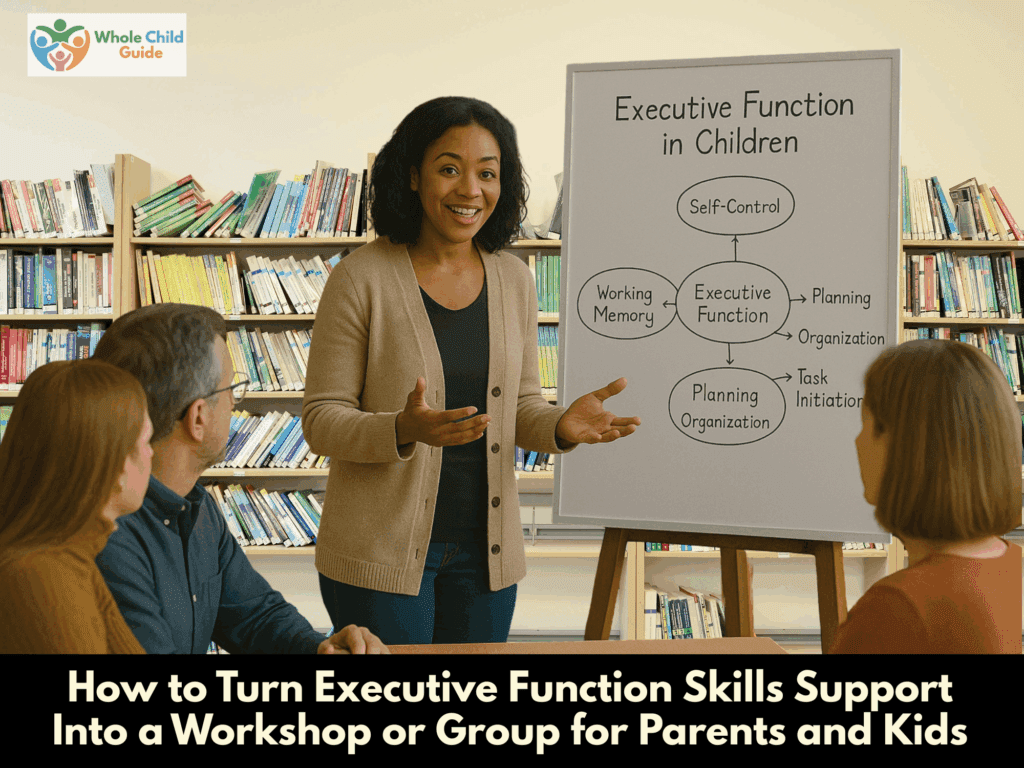
4. Professional Development Training – “Supporting Executive Function Skills in the Classroom”
Length: 60–90 minutes
Audience: Teachers, paraprofessionals, school counselors, or multidisciplinary therapy teams
Setting: School, district in-service, or virtual professional development
Structure Example:
Introduction (5–10 min)
Share why executive function matters in educational settings:
- Students with weak executive function struggle academically even when they’re intelligent
- Many behavioral issues stem from executive function deficits, not willful disobedience
- Early support prevents the “homework wars” and learned helplessness in later grades
- Executive function predicts academic success better than IQ
The Research & Whole Child Lens (10–15 min)
Present brief evidence:
- Brain development timeline (why middle schoolers still need scaffolding)
- Impact of poverty, trauma, and chronic stress on executive function
- How ADHD, anxiety, and learning disabilities intersect with executive function
- Universal Design for Learning (UDL) and executive function supports benefit all students
Hands-On Demonstration (20–25 min)
Lead 5 practical strategies educators can embed into classroom routines:
- Visual Schedules & Agenda Boards – Show daily schedule cards, “First/Then” boards, and how to preview transitions. Demonstrate a 2-minute morning routine: review the schedule, highlight changes, set expectations.
- Chunking & Backwards Planning – Model how to break long-term projects into weekly mini-deadlines. Show a backwards planning template: start with due date, work backwards to create milestones.
- Timers & Time Awareness Tools – Demonstrate different timer types (visual, auditory, app-based). Show how to use them during independent work, transitions, and test-taking. Practice giving effective time warnings.
- Organizational Systems – Share simple systems: color-coded folders, designated “turn-in” bins, inbox/outbox trays, labeled supply stations. Show a 5-minute “Friday folder clean-out” routine.
- Metacognitive Prompts – Teach students to narrate their thinking: “What’s my plan? What do I need? What’s my first step?” Use sentence stems and thinking maps. Model self-talk strategies.
Collaborative Discussion (15–20 min)
Brainstorm classroom applications:
- “Which executive function skill does your class struggle with most?”
- “How would you adapt these strategies for kindergarten vs. 5th grade vs. high school?”
- “What barriers exist in your classroom—time, resources, student resistance?”
Action Plan & Reflection (10–15 min)
Provide templates:
- Classroom visual schedule template
- Project planning backwards map
- Executive function observation checklist
- Parent communication letter explaining classroom supports
Suggested Price:
- $300–600 per 60–90 minute training
- $800–1,000 for half-day workshop (include handouts and slide deck)
Value Add: Provide PD certificates, slide handouts, and a digital resource bundle (visual templates, games, book recommendations, app lists).
What to Include in Any Session
- Multi-sensory, play-based activities that target planning, organization, memory, and flexible thinking (board games, building challenges, scavenger hunts, cooking activities)
- Visuals, checklists, or scripts for consistency and carryover (routine charts, task breakdowns, timer systems, organizational templates)
- Short parent/educator reflection prompts to encourage noticing progress and celebrating small wins
- Simple take-home materials (one-page handouts, blank visual routine templates, strategy cards)
- Follow-up opportunities (email summary, progress tracker, check-in session, or parent portal access)
Marketing and Promotion Tips
Focus messaging on outcomes:
- “Help your child complete homework independently”
- “End the morning chaos with simple routines”
- “Build organization skills that last a lifetime”
- “Stop the constant reminders and power struggles”
Advertise through:
- Local schools, pediatricians, and neuropsychologists
- Community boards, libraries, and tutoring centers
- Social media parent groups (ADHD support groups, parenting forums, school district pages)
- Partnerships with educational therapists, school psychologists, and learning specialists
Create short videos or reels demonstrating:
- A 30-second visual routine in action
- Timer use during homework
- How to create a “launch pad” station
- A quick working memory game families can play
Promote a clear call to action:
- “Register Now – Workshop Fills Fast!”
- “Join Our 4-Week Executive Function Series”
- “Early Bird Pricing Ends This Friday”
- “Limited to 10 Families for Personalized Attention”
Offer early registration or sibling discounts.
Sample Caption:
“Does your child struggle with homework, morning routines, or staying organized? It’s not laziness—it’s developing executive function skills. Join our workshop and learn brain-based strategies to build independence, reduce battles, and set your child up for success. Register today!”
Pricing Summary
| Service Type | Typical Range | Format |
|---|---|---|
| Parent Workshop | $25–35/person or $200–300 flat | 60–75 min |
| Parent-Child Group | $20–25/child or $75–100 for series | 45–60 min |
| Individual/Private Coaching | $75–125/session | 30–45 min |
| Professional Development | $300–600 | 60–90 min |
Add-on opportunities:
- Printable executive function toolkit ($10–20)
- Mini-course recordings ($40–75)
- Individual coaching check-ins ($35–50 for 20 min)
- Customized visual routine creation service ($75–100)
More Opportunities
- Turn one session into a 4-week progressive series: “Understanding Executive Function” → “Building Daily Routines” → “Homework & Time Management” → “Organization Systems That Stick”
- Bundle related skills: “Executive Function + Emotional Regulation” or “Executive Function + ADHD Strategies” for comprehensive programs
- Offer individualized follow-up coaching after group workshops for families who need more support
- Create grade-specific programs: Elementary vs. Middle School vs. High School executive function needs differ significantly
- Partner with other professionals for co-led workshops: OT + educational therapist, school psychologist + learning specialist, parent coach + organizational consultant
- Create digital versions (recorded workshops, downloadable courses, membership sites) for ongoing passive income
- Develop workplace programs for teens and young adults: “Executive Function for College Success” or “Life Skills for Young Adults”
Final Tips for Success
- Start where families are – meet them in their daily struggles (morning chaos, homework battles) rather than leading with clinical terminology
- Normalize executive function challenges – remind parents that these skills develop slowly and unevenly, especially for kids with ADHD or anxiety
- Focus on environmental supports first – external systems (timers, checklists, routines) before expecting internal change
- Teach “good enough” versus perfection – organization doesn’t have to be Pinterest-worthy to be functional
- Include the child in creating systems – co-create visual routines and organizational strategies so they have buy-in
- Celebrate small wins and progress over perfection – remembering their backpack twice this week is growth worth celebrating
- Provide gradual release of responsibility – start with high support and slowly fade prompts as skills develop
- End each session with one concrete next step – too many strategies at once leads to overwhelm and abandonment
Ready to launch your executive function program? Start with one format that fits your practice, pilot it with a small group, refine based on feedback, and grow from there. These skills change lives—and families desperately need this support.