
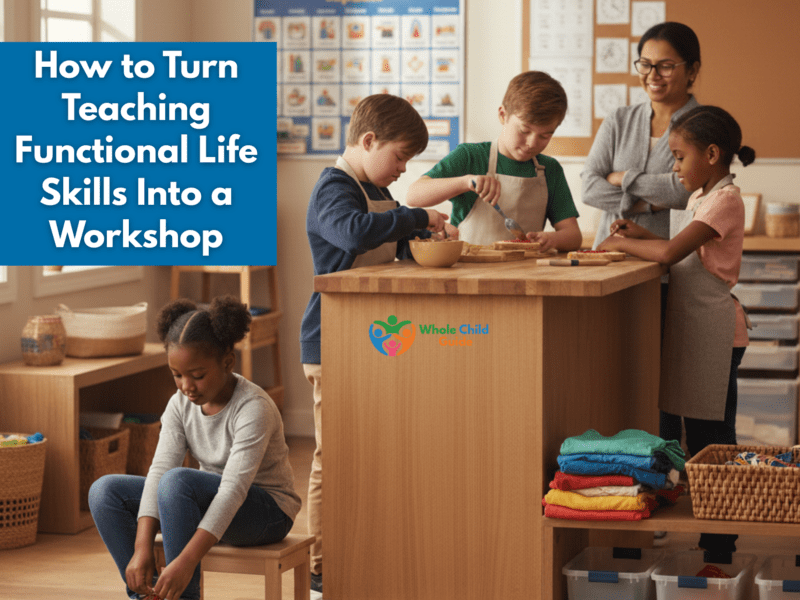
Functional life skills are the practical abilities children need to take care of themselves, manage daily routines, and participate independently in home, school, and community life. These skills include self-care tasks (dressing, grooming, eating), household responsibilities (cleaning, organizing, simple cooking), money management, time management, safety awareness, and community navigation. Functional life skills are the foundation of independence and directly impact a child’s confidence, self-esteem, and long-term success. Teaching functional life skills is a critical step in child development.
Functional life skills don’t develop in isolation. They rely heavily on executive function abilities like planning and task initiation, are influenced by sensory processing differences that can make certain tasks uncomfortable, and often require social skills for asking for help or collaborating with others.
Challenges in this area might look like:
- A 7-year-old who can’t tie their shoes or button their shirt independently
- A 10-year-old who doesn’t know how to make a simple snack or pour a drink safely
- Difficulty with personal hygiene tasks (brushing teeth, washing hands thoroughly, bathing independently)
- Unable to manage basic household chores appropriate for their age (making bed, putting away laundry, clearing dishes)
- No concept of money value or how to make simple purchases
- Difficulty navigating community spaces (ordering food, using public restrooms, asking for help)
- Inability to tell time or understand daily schedules
- Poor safety awareness (stranger danger, fire safety, what to do in emergencies)
- Resistance to learning new life skills, preferring parents to do everything
- Learned helplessness (saying “I can’t” before even trying)
When functional life skills improve, you’ll see:
- Children completing morning and bedtime routines with minimal prompting
- Growing independence in self-care tasks appropriate for their age
- Pride and confidence from mastering new skills
- Contribution to household responsibilities without constant reminders
- Better understanding of time, money, and safety concepts
- Ability to advocate for themselves and ask for help when needed
- Smoother transitions to new environments (sleepovers, camp, college)
- Reduced family stress as children become more self-sufficient
- Parents able to step back and allow age-appropriate independence
- Children developing work ethic and sense of competence
Possible Services to Support Functional Life Skills
Professionals can build various offerings around functional life skills, depending on their setting, training, and audience. Choose one or more of the following models:
- Parent Education Workshop (Virtual or In-Person)
- Parent-Child Group or Play Session
- Individual Session (Private Coaching, Consultation, or Insurance-Based)
- Professional Development Training for Staff or Teams
Each version below includes structure, pricing, and implementation guidance.
Session Format and Structure
1. Parent Education Workshop – “Building Independence: Teaching Your Child Essential Life Skills”
Length: 60–75 minutes
Audience: Parents and caregivers
Setting: Community center, clinic, school, or virtual
Structure Example:
Welcome & Icebreaker (5–10 min)
Greet parents and introduce the topic. Ask: “What’s one life skill you wish your child could do independently?”
Common answers: getting dressed without help, making simple meals, managing homework materials, understanding money, telling time, basic household chores.
Foundations & Science (10–15 min)
Explain how functional life skills develop:
- The progression of independence (what’s appropriate at different ages and why expectations matter)
- Task analysis (breaking complex skills into teachable steps)
- Backward chaining vs. forward chaining (teaching strategies that build success)
- The role of executive function (how planning, sequencing, and initiation affect life skill mastery)
- Sensory considerations (why some tasks feel harder due to texture, temperature, or motor demands)
- The competence-confidence cycle (how mastering skills builds self-esteem and motivation)
Share that teaching life skills requires patience, consistency, and a willingness to let children struggle and make mistakes as they learn.
Practical Strategies (15–20 min)
Demonstrate 3 home-ready strategies:
- “Visual Task Breakdowns” – Show how to create step-by-step visual guides for tasks like tying shoes, making a sandwich, or doing laundry. Demonstrate using photos, drawings, or written checklists. Explain how visuals reduce reliance on verbal reminders and build independence.
- “The Teaching Hierarchy” – Introduce the gradual release model: full physical assistance → hand-over-hand guidance → gestural prompts → verbal prompts → visual cues → independence. Show parents how to systematically fade support rather than doing tasks for children indefinitely.
- “Natural Consequences and Problem-Solving” – Explain how to let safe failures happen (forgot lunch → feel hungry, didn’t put dirty clothes in hamper → no clean clothes available). Demonstrate how to facilitate problem-solving: “What could you do differently next time?” rather than rescuing or lecturing.
Parent Reflection & Q&A (15–20 min)
Facilitate discussion:
- “What life skills are you currently doing for your child that they could learn to do?”
- “What’s your biggest barrier: time pressure, perfectionism, or guilt about making them struggle?”
- “How can you balance helping vs. enabling?”
- Address common concerns: “What if they never do it as well as I do?” or “Isn’t it faster if I just do it myself?”
Wrap-Up & Takeaway (10 min)
Provide a “Life Skills Roadmap” handout with:
- Age-appropriate life skills checklist (preschool through high school)
- Task analysis template for breaking down skills
- Tips for teaching without taking over
- Resources for adaptive equipment or modifications
Suggested Price:
- $25–35 per parent (virtual or community event)
- $200–300 flat rate for school or parent organization-hosted events
Value Add: Include downloadable visual task cards, age-appropriate chore charts, and video demonstrations of common teaching techniques.
2. Parent-Child Playgroup or Group Session – “Life Skills Lab: Learning Through Doing”
Length: 60–90 minutes (longer format works better for hands-on skill practice)
Audience: Small group of 4–6 children (ages 6–14) with parent participation
Setting: Clinic with kitchen/laundry facilities, community center, home economics classroom, or adapted therapy space
Structure Example:
Welcome Circle (5 min)
Use a brief check-in: “Let’s share one thing you’ve learned to do by yourself recently that you’re proud of.”
Preview today’s activities with a visual schedule.
Model the Skill (5–10 min)
Introduce today’s focus (e.g., “Making a Simple Snack,” “Laundry Basics,” or “Money Skills”) through:
- Demonstration with narration of each step
- Discussion of why this skill matters for independence
- Preview of what participants will practice today
Interactive Skill Stations (40–50 min)
Rotate through 3–4 stations where children practice real functional skills:
Station 1: Food Preparation
Kids make simple snacks or meals appropriate for their age: spreading peanut butter, making trail mix, assembling sandwiches, measuring ingredients for no-bake recipes, using microwave safely. Parents coach using the teaching hierarchy: “What’s your first step? Show me how you’ll do it safely.”
Station 2: Self-Care Skills
Practice age-appropriate tasks: shoe tying with lacing cards and real shoes, buttoning/snapping/zipping with dressing boards, face washing and teeth brushing with proper technique, hair brushing and simple styling. Focus on proper technique and independence.
Station 3: Household Tasks
Hands-on practice with real tasks: folding towels and matching socks, sweeping and using a dustpan, wiping tables, sorting recycling, making a bed, organizing a backpack or drawer. Emphasize “good enough” over perfection.
Station 4: Money and Community Skills
Use play money for counting, making change, and mock purchases. Practice reading simple recipes or instruction cards. Work on telling time with analog and digital clocks. Role-play asking store employees for help or ordering food.
Parent Coaching Moment (During Rotations)
Circulate and coach parents:
- “Notice how you let them figure out the next step instead of telling them? That builds problem-solving.”
- “Great job waiting instead of jumping in to fix it.”
- Point out when children successfully complete a step independently.
Reflection & Goodbye Routine (5–10 min)
Circle back together. Ask each child: “What skill did you practice today? What will you try at home this week?”
Give each child a “Life Skills Challenge Card” with one skill to practice at home and a simple tracking sheet.
Suggested Price:
- $25–30 per child per session (higher due to materials and longer format)
- $90–120 for a 4-week series (“Kitchen Skills,” “Self-Care Skills,” “Household Helpers,” “Money & Community Skills”)
Value Add: Include take-home practice materials, visual guides for each skill taught, and resources for adaptive tools if needed.
3. Individual Session – “Personalized Life Skills Coaching”
(Private Coaching, Consultation, or Insurance-Based Therapy)
Length: 45–60 minutes
Audience: Individual child or teen (with parent involvement)
Setting: Clinic, home visit (ideal for life skills), school, or telehealth with limitations
Structure Example:
Assessment & Goal Setting (10–15 min)
Conduct functional skills assessment:
- Use standardized tools if appropriate (Vineland, ABAS, Pediatric Evaluation of Disability Inventory)
- Interview parent and child about priority skills and barriers
- Observe child attempting target skills to identify breakdown points
- Assess related factors: motor skills, sensory sensitivities, executive function challenges, motivation
Targeted Skill Practice (25–35 min)
Work on specific skills based on individual needs:
- For a child struggling with dressing: Break down each component (shirt orientation, arms through sleeves, pulling over head, buttons). Use backward chaining starting with the final step. Address sensory issues with clothing choices. Practice with adapted clothing if needed.
- For a child who can’t make simple meals: Start with no-cook options (cereal, sandwich). Teach kitchen safety (sharp objects, hot surfaces). Practice measuring, spreading, pouring. Build complexity gradually. Address sensory aversions to food textures during preparation.
- For a child with poor hygiene habits: Create visual sequences for bathroom routines, hand-washing, teeth brushing, showering. Use timers for duration. Address sensory issues (water temperature, soap texture). Build habits through consistent practice.
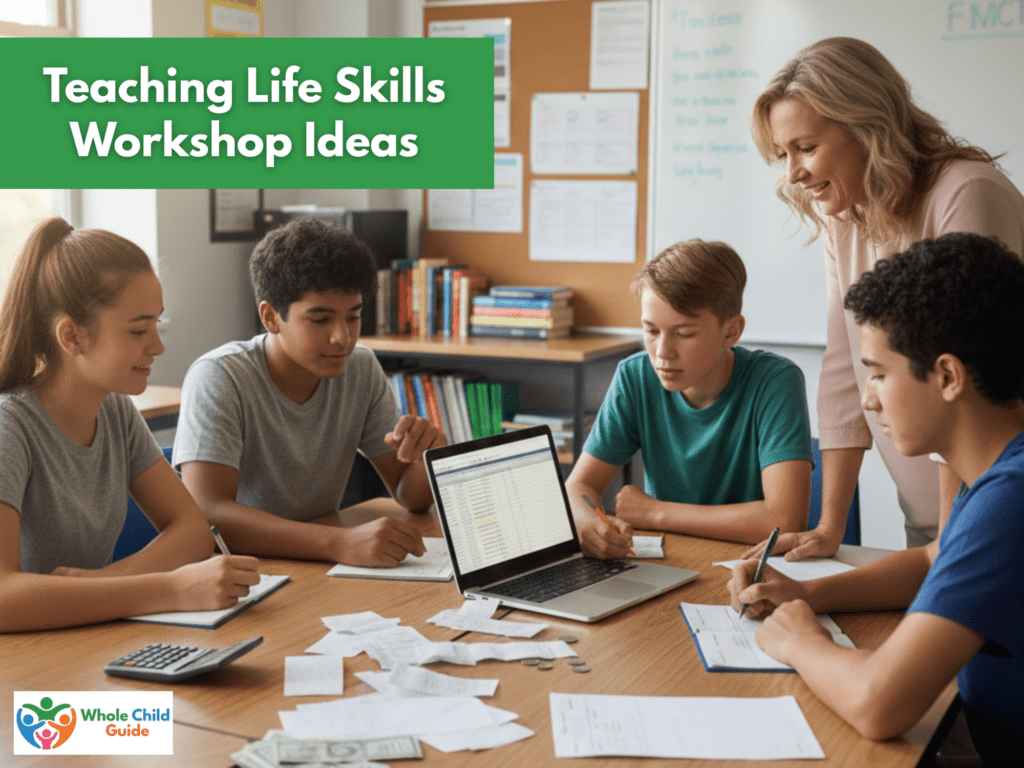
- For a teen lacking money skills: Practice counting money, making change, budgeting for purchases. Use real-world scenarios (grocery shopping list with budget, comparing prices). Teach digital payment awareness. Introduce banking basics if appropriate.
Parent Training & Home Planning (10–15 min)
Equip parents to support practice:
- “Here’s what we worked on. Let’s create a home practice schedule that’s realistic for your family.”
- Provide task breakdowns and visual supports
- Problem-solve barriers: “What time of day works best? How can we make this less rushed?”
- Set up environmental supports (step stool, labels, adaptive equipment)
- Create data collection method to track progress
Wrap-Up (5 min)
Review home practice goal and celebrate progress.
“You completed three steps of shoe-tying independently today. Last week you needed help with all of them. That’s real growth!”
Suggested Price:
- Private pay or consultation: $100–150 per session
- Insurance-based OT session: Bill according to CPT codes (97165–97168 for evaluation; 97535 for self-care/home management training; 97110 for therapeutic activities)
Value Add: Offer written task analyses, customized visual supports, video demonstrations of techniques, home modification suggestions, and adaptive equipment recommendations.
4. Professional Development Training – “Teaching Functional Life Skills in Educational Settings”
Length: 60–90 minutes
Audience: Special education teachers, life skills classroom staff, transition specialists, or therapy teams
Setting: School, vocational program, or virtual professional development
Structure Example:
Introduction (5–10 min)
Share why functional life skills matter in educational settings:
- Legal mandates for transition planning and independent living skills
- Research showing life skills predict post-school success better than academics alone
- Student confidence and engagement increase when learning practical skills
- Family partnership strengthens when schools support real-world competence
- Preparation for employment, community participation, and independent living
The Research & Whole Child Lens (10–15 min)
Present brief evidence:
- Importance of functional skills for students with and without disabilities
- Connection between independence and quality of life outcomes
- How to embed life skills instruction into academic curriculum
- Role of community-based instruction in generalization
- Transition assessment and planning requirements
- Link between life skills and other developmental areas like executive function and social skills
Hands-On Demonstration (20–25 min)
Lead 5 practical strategies educators can implement:
- Task Analysis and Data Collection – Demonstrate how to break down a skill (making coffee, doing laundry, grocery shopping) into teachable steps. Show simple data collection methods. Practice writing measurable IEP goals for functional skills.
- Teaching Strategies – Model forward chaining, backward chaining, total task presentation, and video modeling. Show when to use each approach. Practice fading prompts systematically.
- Embedding Skills Across Settings – Show how to teach skills in natural contexts: cafeteria for food prep, school bathrooms for hygiene, school store for money skills, classroom jobs for responsibility. Discuss generalization strategies.
- Adaptive Equipment and Modifications – Introduce assistive technology and low-tech adaptations: button hooks, elastic shoelaces, adapted utensils, visual schedules, color-coding systems, timer apps. Discuss when modifications support vs. hinder independence.
- Family Collaboration – Demonstrate how to partner with families on skill selection and home practice. Provide templates for home-school communication. Show how to train families in teaching techniques.
Collaborative Discussion (15–20 min)
Brainstorm applications:
- “What functional skills do your students need most?”
- “What barriers exist: time, space, materials, or administrative support?”
- “How can we balance academics with life skills instruction?”
Action Plan & Reflection (10–15 min)
Provide templates:
- Functional skills assessment checklist
- Task analysis template
- IEP goal bank for life skills
- Home-school communication forms
- Community-based instruction planning guide
Suggested Price:
- $300–600 per 60–90 minute training
- $800–1,000 for half-day workshop (include handouts and slide deck)
Value Add: Provide PD certificates, slide handouts, video examples of teaching techniques, task analysis libraries, and digital resource bundle.
What to Include in Any Functional Life Skills Session
- Real, hands-on practice with actual materials and tasks (not just discussion or worksheets)
- Age-appropriate skills that match developmental readiness and family priorities
- Visual supports and task breakdowns for consistency and independence building
- Parent/educator training on teaching techniques, not just telling children what to do
- Emphasis on gradual independence through systematic prompt fading
- Celebration of effort and progress over perfection
- Follow-up opportunities for continued practice, troubleshooting, and skill advancement
Marketing and Promotion Tips
Focus messaging on outcomes:
- “Build your child’s independence and confidence”
- “Stop doing everything for your child”
- “Prepare your child for real-world success”
- “Teaching life skills that last a lifetime”
Advertise through:
- Occupational therapy clinics and pediatric practices
- Special education departments and transition programs
- Parent support groups and autism/disability organizations
- Community recreation centers and libraries
- Social media parenting groups focused on independence and responsibility
Create short videos or reels demonstrating:
- A task analysis in action (tying shoes in 8 steps)
- Backward chaining technique with a real skill
- Before/after of a child mastering a new skill
- Simple visual supports parents can create
Promote a clear call to action:
- “Register Now for Life Skills Lab”
- “Join Our Independence Workshop”
- “Limited Spots for Hands-On Learning”
- “Early Bird Pricing Ends This Week”
Offer sibling discounts or family packages.
Sample Caption:
“Want your child to be more independent? Join our Life Skills Lab where kids learn practical skills like cooking, cleaning, money management, and self-care through hands-on practice. Build confidence and competence that lasts a lifetime. Register today!”
Pricing Summary
| Service Type | Typical Range | Format |
|---|---|---|
| Parent Workshop | $25–35/person or $200–300 flat | 60–75 min |
| Parent-Child Group | $25–30/child or $90–120 for series | 60–90 min |
| Individual/Private Coaching | $100–150/session | 45–60 min |
| Professional Development | $300–600 | 60–90 min |
Add-on opportunities:
- Life skills toolkit with visual supports ($15–25)
- Individualized task analysis creation ($50–100)
- Home consultation for environmental modifications ($150–250)
- Cooking or money skills mini-courses ($40–75)
Additional Opportunities to Support Functional Life Skills
- Turn one session into a progressive series by skill category: “Kitchen Independence” → “Self-Care Mastery” → “Household Helpers” → “Money & Community Skills”
- Offer age-specific programs: “Little Helpers (ages 4-7),” “Growing Independence (ages 8-12),” “Teen Life Skills,” “Transition to Adulthood (ages 16-21)”
- Bundle related skills: “Life Skills + Executive Function” or “Life Skills + Social Skills” for comprehensive independence support
- Create specialized programs: “Cooking Classes for Kids,” “Money Management Workshop,” “Laundry 101,” “Basic Home Repair for Teens”
- Partner with community businesses for real-world practice: grocery stores, banks, restaurants, laundromats
- Develop summer camps or break programs focused on intensive life skills practice in fun contexts
- Create digital versions (video tutorials, online courses, downloadable task libraries)
- Offer transition planning services for students with IEPs approaching adulthood
- Develop family coaching packages where you work with the whole family system on building independence
Final Tips for Success
- Start with skills that matter most to the family rather than working through a predetermined curriculum
- Expect messiness and mistakes – learning requires doing, and doing means imperfect results at first
- Teach during real activities, not simulations whenever possible (real kitchen, real laundry, real money)
- Balance support with allowing struggle – children learn from figuring things out
- Use natural consequences when safe (forgot lunch, wore mismatched clothes) rather than always rescuing
- Celebrate independence, not perfection – “good enough” done independently beats “perfect” done with help
- Adjust expectations based on ability – some children need adaptations or will master skills later than peers
- Address underlying challenges like sensory sensitivities or executive function difficulties that interfere with skill mastery
- Build skills during calm times – not when rushing out the door or when everyone is tired
- Partner with families on priorities – what they value and their daily routines should drive skill selection
Ready to launch your functional life skills program? Independence is one of the greatest gifts you can help children develop. These practical skills build confidence, reduce family stress, and prepare children for successful futures. Start with one format, teach real skills that families need, and watch the transformation happen. For more on how functional life skills fit into whole child development, check out our comprehensive guide to functional life skills and the whole child.