
If your child has intense reactions (crying, yelling, shutting down, or completely losing control), you may find yourself wondering what’s really going on and how to help. Meltdowns can feel unpredictable and overwhelming, leaving parents unsure whether this is typical development, behavior that needs to change, or a sign of something deeper. Through a whole child lens, meltdowns are not simply “bad behavior.” They are often a signal that a child’s nervous system is overwhelmed and struggling to cope with what’s happening around or inside them. When we begin to look beneath the surface, we can better understand the why behind these moments, and respond in ways that support regulation, connection, and long-term growth.
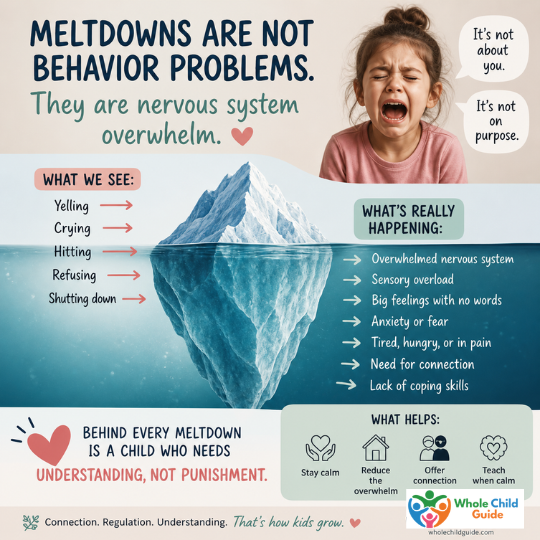
Meltdowns are not behavior problems. They are nervous system responses.
If your child has intense emotional outbursts, you may be wondering:
- “Why is this happening?”
- “Is this normal behavior?”
- “How do I help my child calm down?”
Meltdowns can feel overwhelming for both children and caregivers. But when we step back and look through a whole child lens, we begin to understand something important…That the meltdown we see in action is a response to a need we don’t see.
The Iceberg Model for Meltdowns
You’ve probably seen memes about the iceberg model. You know the one: a picture of an iceberg with things we see on top of the water: behaviors, trouble at school, etc. But beneath the water is the majority of the iceberg’s mass. That’s where we have the bulk of the things making up the top of the iceberg. I like to use this iceberg model as a visual representation of meltdowns. What you see is the meltdown. The behaviors the child is doing. But what is actually causing those actions is what’s underneath the surface. It might be lack of sleep, sensory needs, trauma, family issues…any number of things contributing to the things we see the child (or any aged human) doing.
What You See vs. What’s Underneath
One of the most helpful ways to understand meltdowns is the iceberg model.
Above the surface (what we see):
- Yelling
- Crying
- Hitting or throwing
- Refusing
- Running away
- Shutting down
Below the surface (what’s really happening):
- Sensory overload
- Anxiety or fear
- Fatigue or poor sleep
- Hunger or physical discomfort
- Difficulty communicating needs
- Frustration with expectations
- Lack of coping skills
- Overwhelmed nervous system
When we focus only on the behavior, we miss the root cause. When we look below the surface, we can respond in ways that actually help.
What’s Happening in the Nervous System?
During a meltdown, a child’s brain shifts into survival mode. This is often described as fight, flight, or freeze.
This means:
- The thinking brain goes offline
- The body becomes reactive
- Emotions feel intense and urgent
- Logical reasoning doesn’t work
This is why saying “calm down” or “use your words” often doesn’t help in the moment. The child isn’t choosing the reaction. Their nervous system is overwhelmed.
From a whole child perspective, meltdowns are signals that:
“This is too much for me right now.”
Why Do Meltdowns Happen?
Meltdowns are often the result of stacked stressors, not just one event.
Common contributors include:
1. Sensory Overload
Busy environments, loud sounds, bright lights, or uncomfortable textures can overwhelm the nervous system. We cover how to support sensory needs through a whole child lens in one of our most popular articles. There are many ways that sensory needs can lead to meltdowns, and they might be things we don’t always think about.
For example, in our blog post on sensory issues related to sleep, we can see that sensory impacts sleep and that very much may be a contributing factor related to meltdowns.
2. Emotional Regulation Challenges
Children are still learning how to identify and manage feelings. It’s a must to take a look at emotional regulation needs when kids have outbursts that impact function. We can support areas like anger in kids with a holistic approach. Or, we can support Social-Emotional Skills Through a Holistic View. We can also take a whole child approach to support anxiety or worries.
3. Communication Difficulties
When children can’t express what they need, frustration builds. That’s where we see social skills fall apart and sometimes the meltdown is the result of these issues. A speech therapist can help with the communication needs. And, when we look at other areas impacting language and communication, we can really get to the bottom of things. For example, we cover some of these considerations in our blog post on helping with communication needs.
4. Executive Functioning Demands
Transitions, expectations, and problem-solving can overwhelm developing brains. All of this is part of executive functioning in kids and can lead to meltdowns when challenges exist. When children manage the working memory skills to help with regulating emotions, we start to see some self-awareness skills in managing meltdowns. And, when kids start to have the ability to shift between tasks, they are better prepared to learn, form relationships, and handle everyday challenges.
Difficulties in executive functioning can show up as forgetfulness, poor impulse control, or disorganization. These are skills needed for managing big emotions.
By focusing on executive function and child development, we lay the foundation for growth in learning, independence, and emotional well-being.
5. Fatigue and Sleep
We mentioned sleep above, but this is actually a big part of the whole child lens. That’s why we have a whole series on sleep and the whole child.
Tired children have less capacity to regulate. For example, helping teenagers get the right amount of sleep can help with older kids who have meltdowns. And helping toddlers that wake up during the night can help with getting a restful night’s sleep which helps with Toddler meltdowns.
That’s when things aren’t so simple and we might need to seek out a professional or a sleep specialist to help.
6. Anxiety and Internal Stress
Worry, fear, and pressure can build under the surface. Taking a holistic approach with anxiety is helpful because those worries often translate to meltdowns.
What Meltdowns Are NOT
It’s important to separate meltdowns from intentional misbehavior.
Meltdowns are NOT:
- Manipulation
- Attention-seeking
- Defiance
- A lack of discipline
They are:
- Loss of control
- Overwhelm
- A need for support
What to Do During a Meltdown
When a child is in meltdown mode, the goal is not to teach during the actual moment when a meltdown is happening. That approach won’t be effective at all. It’s like trying to teach when a train is barreling down the tracks outside a classroom. The goal with a holistic approach for meltdowns is to help them feel safe and regulated by considering all of the aspects of the whole child and supporting all of the needs.
Some ways to help include:
1. Stay Calm (Co-Regulation)
Your calm nervous system helps their nervous system settle.
2. Reduce Input
Lower noise, lights, and demands.
3. Offer Presence, Not Pressure
You might say:
- “I’m here.”
- “You’re safe.”
- “We’ll figure this out together.”
4. Avoid Reasoning in the Moment
Save problem-solving for later.
What to Do After a Meltdown
Once your child is calm, this is when learning happens.
- Talk through what happened
- Identify feelings and triggers
- Practice alternative strategies
- Build emotional language
This is where growth occurs over time.
Preventing Future Meltdowns (Whole Child Strategies)
When you look at the whole child, you can start to make connections between what the child needs and why they are responding the way they are.
Build Regulation Skills Daily
- Movement breaks
- Sensory input (deep pressure, swinging, quiet time)
- Predictable routines
Support Communication
- Teach feeling words
- Model expressing needs
Reduce Overwhelm
- Break tasks into smaller steps
- Prepare for transitions
Strengthen the Nervous System
- Sleep
- Nutrition
- Movement
When to Seek Support
If meltdowns are frequent, intense, or impacting daily life, a whole child team can help.
This may include:
- Occupational therapy for sensory and regulation support
- Speech therapy for communication and emotional expression
- Physical therapy for body awareness and regulation- How Can Physical Therapy Near Me Help?
- Parent coaching or counseling
- Sleep training expert– These are professionals who are experienced in sleep training
You can find support through the Whole Child Guide Directory or by using our connection tool to connect you to the support professionals you need.
Final Thought
Every meltdown is a message.
When children feel safe, supported, and understood, those messages become easier to express, and over time, meltdowns become less frequent and less intense.
Because the goal isn’t perfect behavior.
The goal is a child who feels safe in their body, understood in their emotions, and supported as they grow.