
Friendships and peer relationships don’t exist in isolation. They are deeply connected to a child’s ability to understand emotions, manage reactions, communicate needs, and navigate social expectations. When children struggle socially, it’s often a signal that they need support in one or more underlying skill areas. This is not to say that they “don’t like people” or “aren’t social.” Taking time to understand Social-Emotional Skills Through a Holistic View helps caregivers see how emotional regulation, empathy, self-awareness, and connection all work together to support meaningful relationships and long-term social success.
When children struggle with friendships, parents are often left wondering what to do next, and professionals are often asked to help untangle what’s really going on beneath the surface. These questions sit at the intersection of development, emotion, communication, and regulation. By looking at friendship challenges through a whole child lens, caregivers gain clarity and reassurance, while therapists, educators, and coaches gain insight into how different skill areas may be influencing social success.
The sections below are designed to help families feel supported and informed, and to give professionals a shared framework they can use when guiding parents through social and peer relationship concerns.
Friendships matter deeply to children! And this is true for the parents watching from the sidelines, as well. Many caregivers come to us with questions like:
- “My child wants friends but doesn’t know how to join play.”
- “Is my child shy, anxious, or socially delayed?”
- “What if my child is too sensitive and gets overwhelmed in groups?”
- “How do I help my child make and keep friends?”
These are important questions, and there is rarely a single, simple answer. Friendship development is complex. It involves communication, emotional regulation, sensory processing, motor skills, and confidence, all developing at different rates. That’s why looking at friendships through a whole child approach is so helpful.
Friendship Is More Than “Being Social”
Friendship skills are built on multiple developmental foundations. A child may want friends but struggle with one or more of the underlying skills needed to connect.
From a whole child perspective, friendships depend on:
- Play skills – knowing how to enter, sustain, and exit play
- Emotional intelligence – recognizing and managing feelings
- Perspective-taking – understanding others’ thoughts and reactions
- Self-advocacy – expressing needs, boundaries, and preferences
- Regulation – staying calm and flexible in dynamic social settings
When one area is harder, social interactions can feel overwhelming rather than enjoyable.
“My Child Wants Friends but Doesn’t Know How to Join Play”
Joining play is one of the most challenging social skills for children. It requires timing, observation, language, and confidence, all at once.
Some children don’t know:
- How to watch a group and figure out what’s happening
- What words to use to enter play
- How to handle being ignored or told “no”
Play-based learning is critical here. Through structured and unstructured play, children learn turn-taking, negotiation, and flexibility.
You can learn more about how play supports development in our post on Social Skills and Play, where we cover social skills from a holistic lens.
Professionals who often help with play skills:
- Occupational therapists (OTs) – support play organization, regulation, and sensory needs
- Speech therapists (SLPs) – support language for entering play and maintaining conversations
- Social skills groups – offer supported peer practice in a safe environment
“Is My Child Shy, Anxious, or Socially Delayed?”
Shyness, anxiety, and social skill delays can look similar, but they are not the same.
- Shy children may warm up slowly but engage once comfortable
- Anxious children may avoid social situations due to fear or worry
- Socially delayed children may not yet have the skills to participate successfully
A whole child lens looks at why a child is holding back, not just what their behavior looks like.
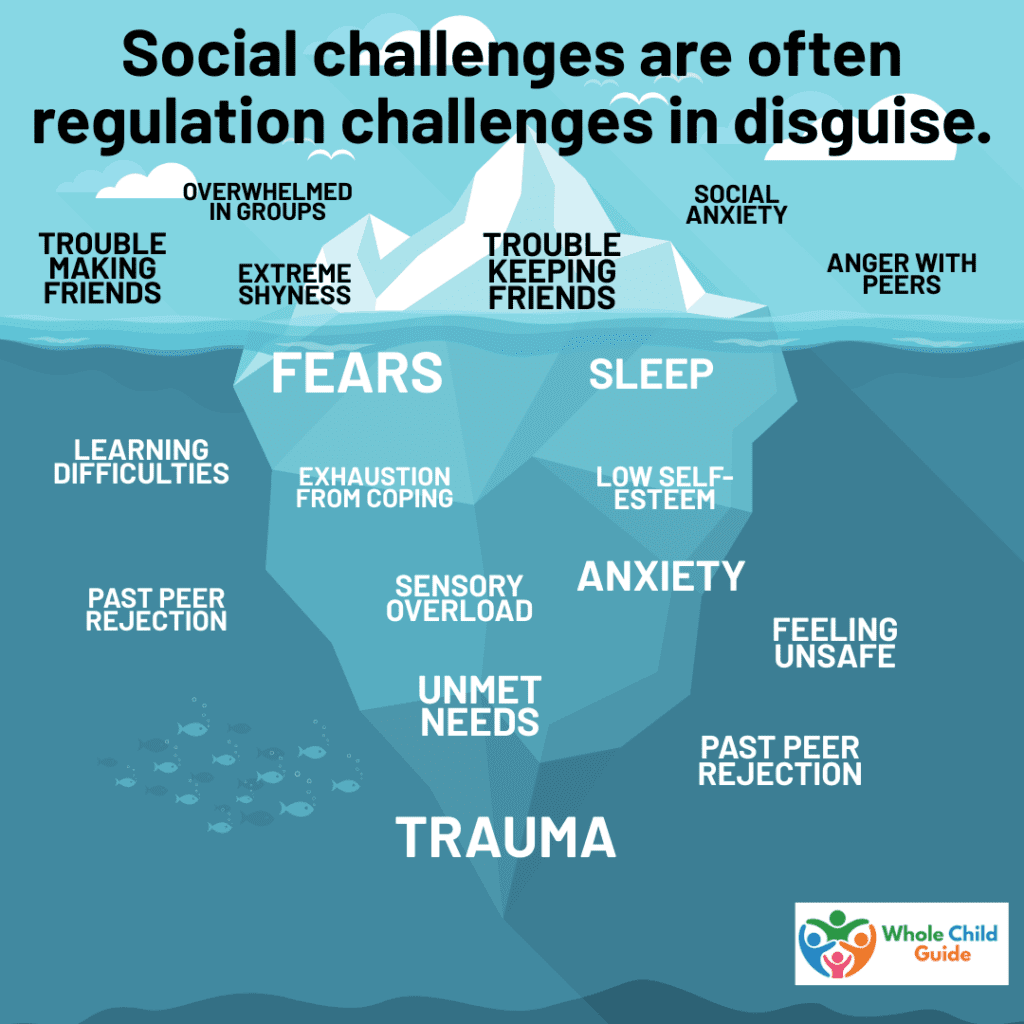
Sleep, sensory processing, and emotional regulation often play a role. For example, children who are overtired or dysregulated may have fewer resources for social interaction.
Related reading:
- How Much Sleep Do School-Age Children and Teenagers Really Need?
- My Child Has Sensory Issues — What Can We Do to Help Them Fall Asleep and Stay Asleep?
“My Child Is Too Sensitive and Gets Overwhelmed in Groups”
Some children experience social environments as sensory overload. Noise, movement, unpredictability, and emotional intensity can quickly overwhelm their nervous system.
When this happens, children may:
- Withdraw or shut down
- Become irritable or emotional
- Appear “too sensitive” or reactive
- Avoid group activities altogether
Occupational therapists are especially skilled at supporting sensory regulation, helping children build tolerance for group settings while honoring their individual needs.
This doesn’t mean forcing children into uncomfortable situations, it just means building regulation and resilience gradually.
Emotional Intelligence and Perspective-Taking
Friendships require more than shared interests. Children must learn to:
- Read facial expressions and body language
- Understand that others have different thoughts and feelings
- Repair conflicts after misunderstandings
These skills develop over time and often need explicit teaching.
Speech therapists, counselors, and parent coaches can help children practice:
- Naming emotions (part of managing big emotions)
- Understanding cause-and-effect in social situations
- Responding flexibly when play doesn’t go as planned
Communication support is often key. Learn more here in our post on How Can Speech Therapy Near Me Help?
Self-Advocacy: A Key to Lasting Friendships
Self-advocacy helps children:
- Ask to join play
- Say “stop” or “I don’t like that”
- Request help from adults
- Set boundaries with peers
Children who struggle to express needs may feel powerless in social situations, leading to frustration or withdrawal.
Parent coaching and therapy can support families in teaching these skills in everyday routines, not just therapy sessions.
How Parents Can Support Friendship Skills at Home
While professional support can be valuable, daily experiences matter too. Parents can help by:
- Talking through social situations after they happen
- Practicing play scripts (“Can I play?” “What are you playing?”)
- Arranging short, low-pressure playdates
- Validating feelings after social challenges
- Focusing on effort and learning, not popularity
For younger children, understanding sleep, regulation, and routine can also support social success:
A Whole Child Team Supports Friendship Growth
Friendship challenges are rarely just “social problems.” They are often a signal that a child needs support in regulation, communication, confidence, or sensory processing.
A whole child team may include:
- Occupational therapists
- Speech therapists
- Physical therapists
- Counselors or psychologists
- Parent coaches
- Educators and caregivers
- Online therapists
You can find professionals who support social and emotional development using the Whole Child Guide Directory.